THE ART OF BETTER BASS
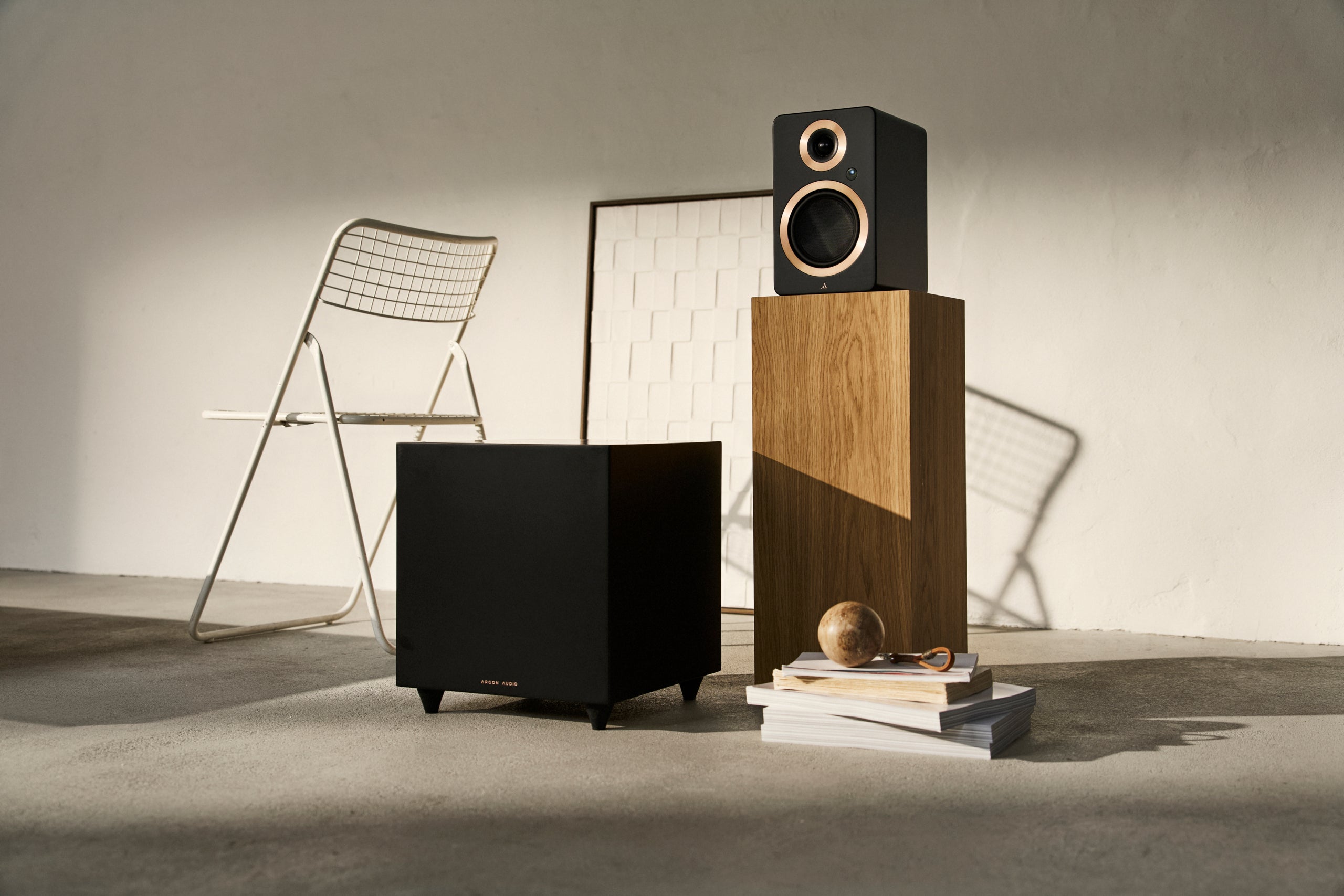
BERLIN SUB 10 and BERLIN SUB 12 look like they came to behave; compact cabinet, clean Scandinavian finish, no visible driver.
Then you press play.
Suddenly films hit harder. Music gains weight, scale and physical energy. Games feel bigger, deeper and more immersive. The room changes character and your entire system sound bigger, fuller and more complete. All because of a relatively unassuming box.
That is the essence of the BERLIN subwoofers. This kind of performance doesn’t come easy. To squeeze as much performance as possible out of these tiny boxes, our engineers had to develop some of the most groundbreaking and innovative subwoofer technology seen so far (if we do say so ourselves).
Behind the polite-looking cabinet is a tightly integrated bass system with a custom long-stroke woofer, a powerful Pascal Audio Class D amplifier, advanced DSP processing, Real Time Bass™, Speakermatch™ and built-in MATRIX Wireless™ capability.
The result is deep, fast and controlled bass that feels dramatically bigger than the cabinet suggests, while staying easy to place, easy to adjust and easy to live with.
So, this one goes out to you. The music-loving people of the world who want excellent, audiophile performance and stylish, modern looks all in one box.
It’s finally here, and it’s we call it BERLIN.

THIS IS
BERLIN SUB
The series consists of two models:
BERLIN SUB 10 and BERLIN SUB 12.
Both utilize the same technologies, have the same features and deliver a whopping 500 W RMS / 1200 W peak power. Both are designed for accurate, controlled bass reproduction across music, films and games. And both are finished in a clean Scandinavian design that fits naturally into modern homes.
The difference is scale.
BERLIN SUB 10 is the compact powerhouse. It is the easiest to place, the most discreet in size and still capable of delivering bass that feels far larger than expected.
BERLIN SUB 12 is the bigger-impact option. It adds more cone area, more physical authority and more headroom for larger rooms or listeners who want the full low-frequency experience.
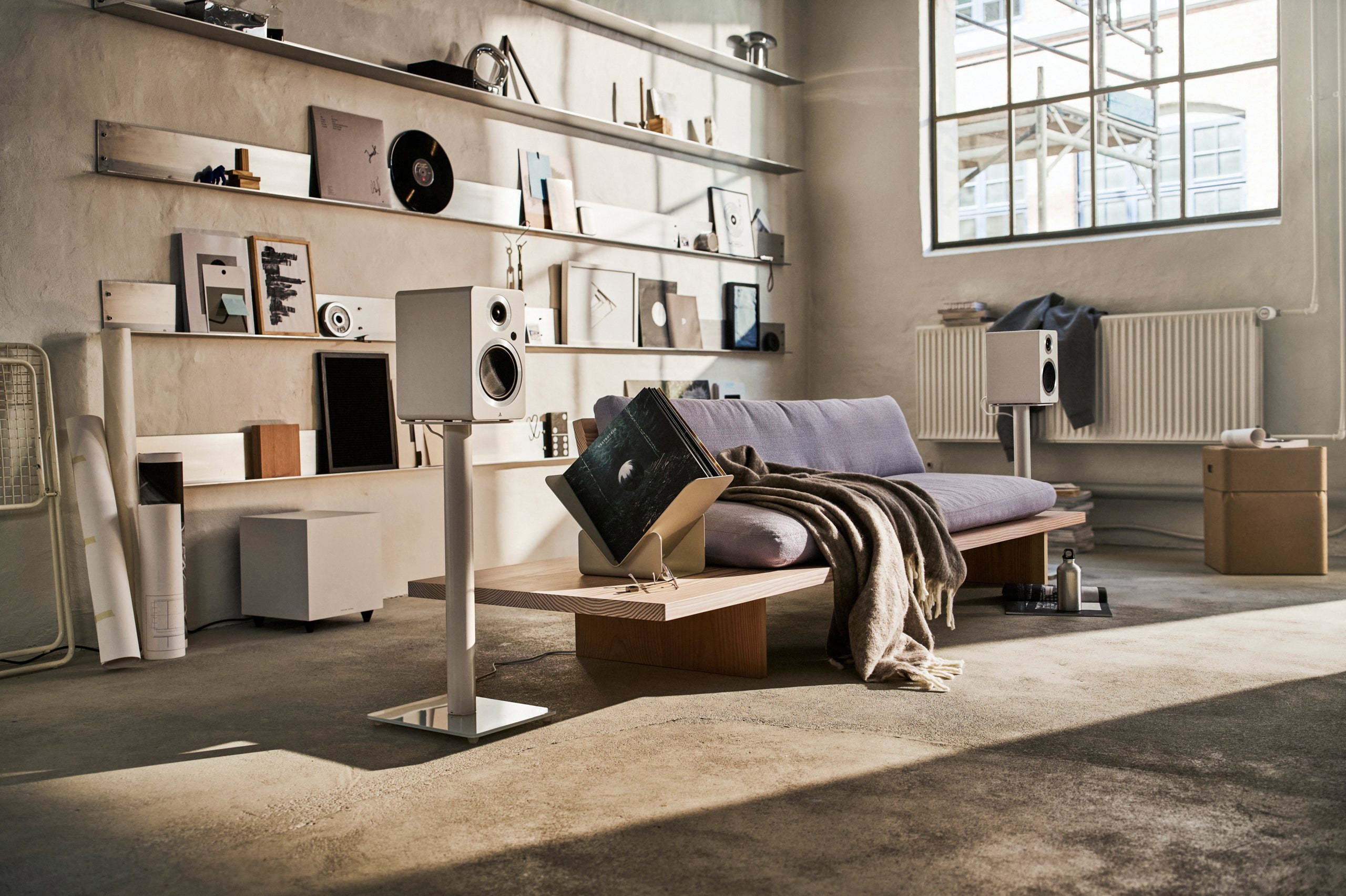
"BERLIN SUB is designed around a simple idea: better bass should make the whole system better, and you shouldn’t need an engineering degree to integrate it properly in your sound system.
It should make your speakers sound bigger, fuller, and more effortless, without the bass ever becoming distracting. We wanted to create a subwoofer that audiophiles could take seriously, but that anyone could set up and enjoy. That balance of performance, control, and ease of setup is what makes BERLIN SUB different”
Henrik Sørensen
CEO of Nordic Hi-Fi
ACOUSTIC DESIGN
CLOSED-BOX CONTROL
BERLIN SUB uses a closed-box cabinet because control matters. A closed box (sealed) design gives the woofer and DSP platform a predictable acoustic environment to work with. There is no bass reflex port adding its own timing behaviour, no port noise and no tuning frequency where the cabinet suddenly changes character. Instead, the woofer, amplifier and DSP can work together for a more controlled and consistent response.
The downside to a closed box is that it takes a lot of power to get the same output as you’d normally get in a ported box. When you want deep bass from a relatively small cabinet, every part of the system needs to pull in the same direction:
- The custom long-stroke woofer provides the air movement
- The Pascal Audio Class-D amplifier provides the power
- The DSP controls the behaviour of the system in real time
- The sealed cabinet gives it all a stable foundation
All these parts are engineered to work perfectly together and become more than the sum of its individual parts. This is why BERLIN SUB can sound both physical and precise. It is designed to deliver powerful yet controlled low-frequency output that works for music as well as films and gaming.
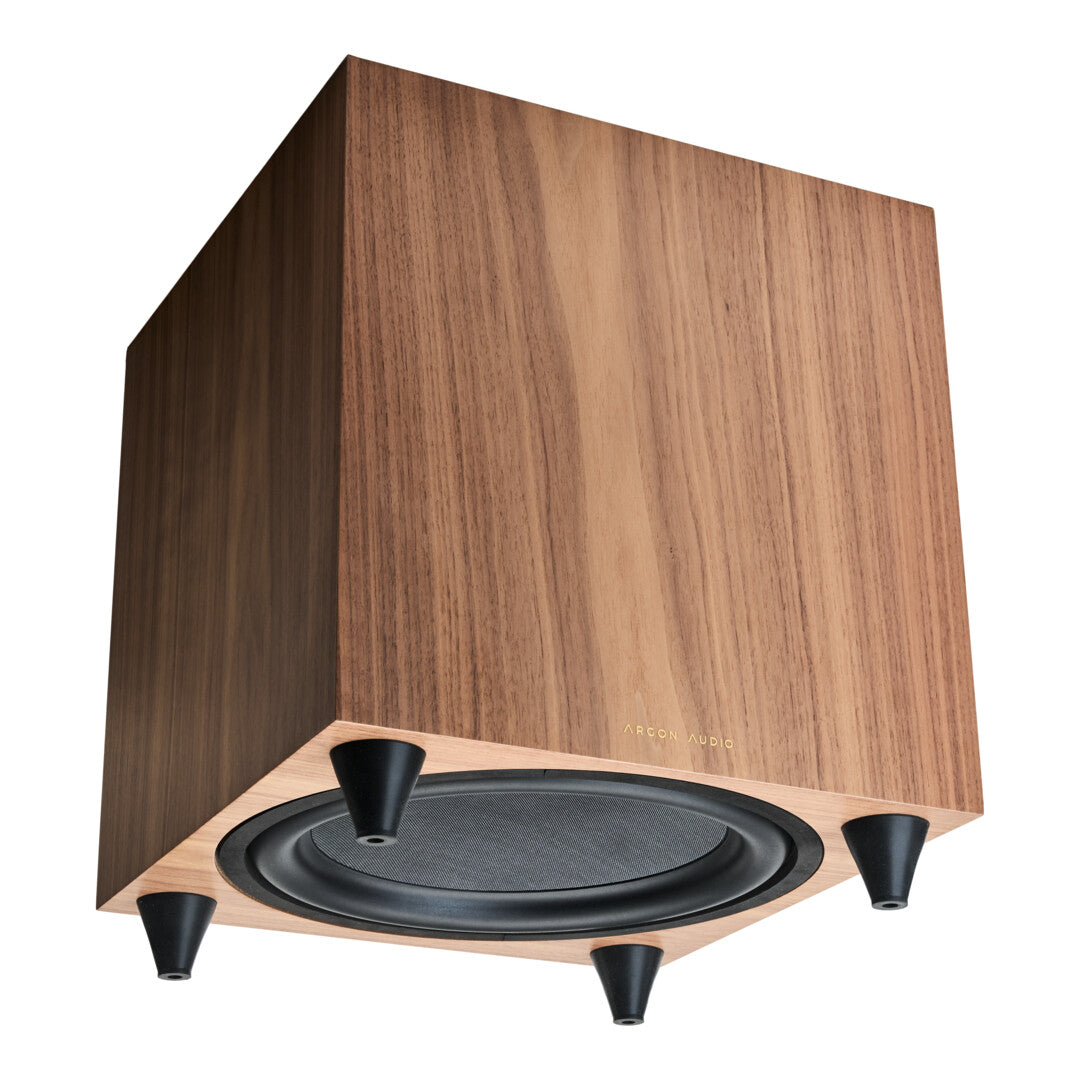
The woofer in BERLIN SUB is down-firing, which means that the driver is hidden from normal view, allowing the front and sides of the cabinet to stay clean and blend in with the rest of your home. From most angles, BERLIN SUB looks more like a simple wooden box on feet than a traditional subwoofer.
But the down-firing design is not only about appearance. This design choice also disperses low-frequency sound waves across the room more evenly. Because low frequencies are omnidirectional, the orientation of the woofer does not inherently compromise sound quality or how much of it travels through walls and floors. In other words, a down-firing subwoofer is no more demanding on your neighbours than a comparable front-firing design. Thus, BERLIN SUB is less visually sensitive to placement and can sit discreetly beside a wall, near furniture or in the position that makes the most sense acoustically.
CUSTOM WOOFER
SERIOUS AMPLIFIER. SMART DSP.
At the heart of BERLIN SUB is a custom long-stroke glass fibre woofer. Both the 10-inch and 12-inch woofer are designed for deep excursion, high output and controlled movement. A subwoofer driver has to move a lot of air, but it also has to do so in a controlled manner. Uncontrolled movement creates distortion, boomy bass and compression. Controlled movement creates punch, texture and impact, making it much easier to distinguish even the deepest of bass notes from each other.
The woofer is powered by a Class D amplifier from the Danish company Pascal Audio delivering 500 W RMS and 1200 W peak power. This gives BERLIN SUB the current and headroom needed for serious low-frequency performance, while keeping the amplifier compact and efficient.
The amplifier and woofer are controlled by BERLIN’s advanced DSP (digital signal processing) platform. This is where the subwoofer becomes more than a powered driver in a box.
The DSP manages everything from filters, timing, driver behaviour, protection, room EQ to Speakermatch™ and Real Time Bass™ processing.
With all this power, you also need some good decoupling. BERLIN SUB rests on specially designed rubber isolation feet that decouple the cabinet from the floor. This reduces the transfer of vibrations into your floors while helping the cabinet remain mechanically stable during high-output playback.
Less energy is lost to vibrations in the floor, allowing more of the woofer’s output to be converted into clean, controlled bass. The result is lower structural vibration, reduced disturbance to neighbours and a cleaner low-frequency presentation.
NOTE: BERLIN SUB also includes a 3-band notch filter room EQ. This is especially useful for taming specific room resonances. In many rooms, bass problems are not spread evenly across all low frequencies. A notch filter lets you reduce that problem area without pulling down the entire bass range.

MATRIX WIRELESS
Have you ever crawled around on the floor trying to find the exact spot where your sub sounds the best, only to find out you need a 10-metre subwoofer cable to reach it?
Subwoofer placement matters and sometimes the best place for bass is not the most convenient place for a cable. This is why BERLIN SUB comes with MATRIX Wireless™ capability built in.
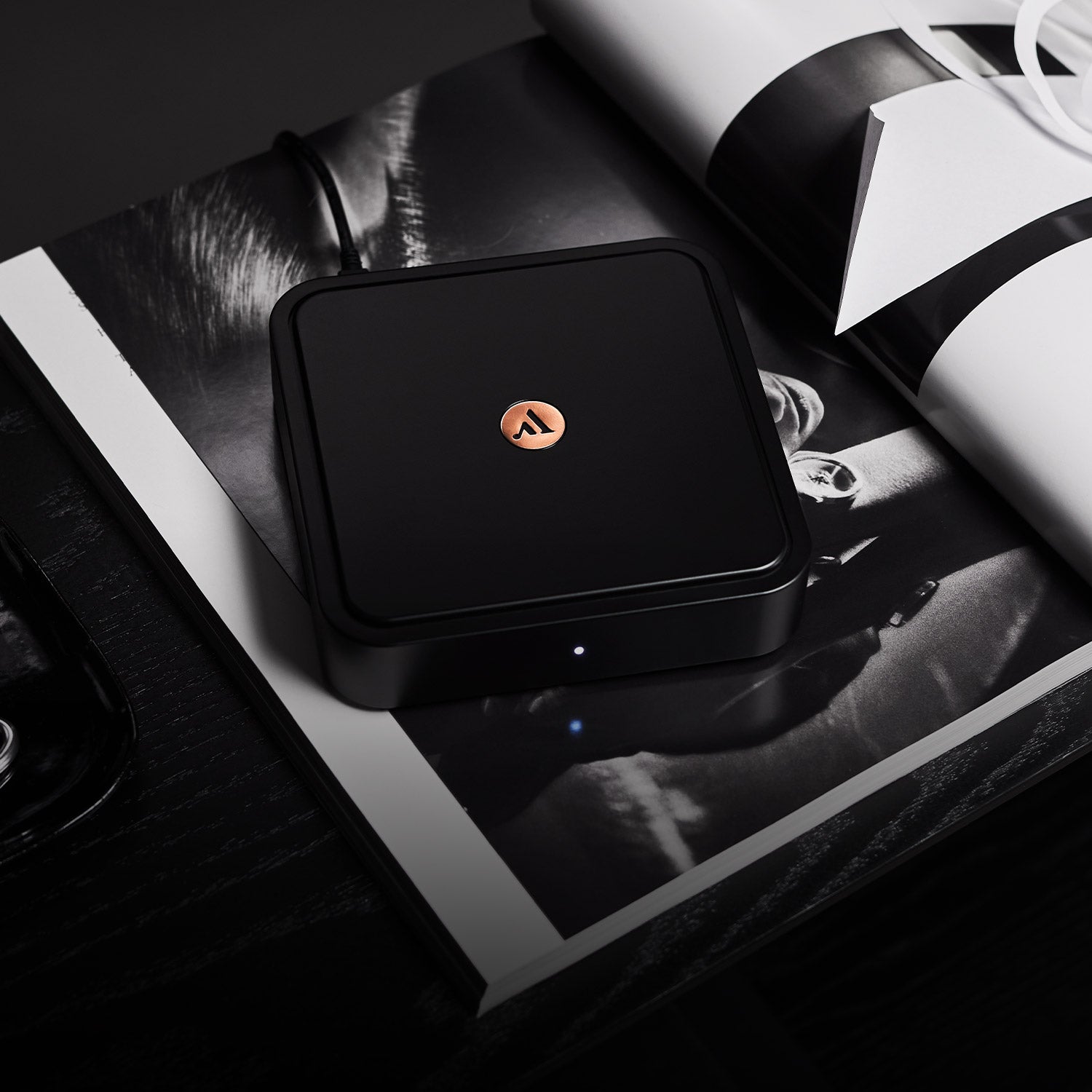
When paired with the optional MATRIX transmitter, BERLIN SUB can receive the audio signal wirelessly from your amplifier, speakers or other source. The subwoofer still needs power, of course, but the long signal cable across the room can disappear. This gives you more freedom to place the subwoofer where it performs best acoustically or where it fits best visually.
During development of MATRIX Wireless™, our engineers aimed for stable, low-latency audio transmission in real homes, where routers, phones, laptops, smart devices and other wireless products all share the air. The system continuously monitors the wireless environment and automatically selects the most stable connection, helping BERLIN SUB maintain reliable performance in busy wireless spaces.
And because the MATRIX Wireless™ receiver is already built into BERLIN SUB, no extra receiver box is needed at the subwoofer end. Just add the transmitter, connect power and place the subwoofer where it makes sense.
NOTE:
Because the MATRIX transmitter continuously monitors the wireless environment, it can take up to 24 hours from initial setup to get an accurate picture of the environment. Since it’s continuous, any changes to placement of either subwoofer or transmitter will eventually be accounted for in the calibration.
REAL TIME BASS
Real Time Bass™ tackles one of the most common and frustrating challenges in subwoofer design: delay. Conventional subwoofers often overlook the effects of group delay and phase distortion, which makes it harder to integrate the subwoofer with the main loudspeakers.
That may sound like a small detail, but it is one of the most important factors in how a subwoofer actually sounds. Your main speakers and subwoofer are supposed to perform as one coherent system. When the subwoofer is even slightly delayed, the result can be bass that feels slower, softer or disconnected from the rest of the music. This is also one of the classic reasons people say subwoofers aren’t great for music.
BERLIN SUB combines a dedicated real-time DSP platform, phase-optimised bass extension and purpose-built hardware engineered specifically for real-time signal processing. With ultra-low processing delay and compensation for the physical behaviour of the custom woofer, the system helps the bass stay perfectly in step with your main speakers.
Rather than relying on heavy protective filtering or aggressive limiting, the DSP continuously monitors incoming transients and makes corrections in real time. This preserves the attack and rhythm of the original recording while allowing exceptionally deep bass extension without sacrificing speed or precision.
The result is a subwoofer that doesn’t sound like a separate subwoofer at all. It disappears into the system. Kick drums hit with real impact. Bass guitars have texture and rhythm. Movie effects carry weight without smearing into the next note. Instead of a slow wave of bass arriving after everything else, you get bass that starts and stops exactly when it should.
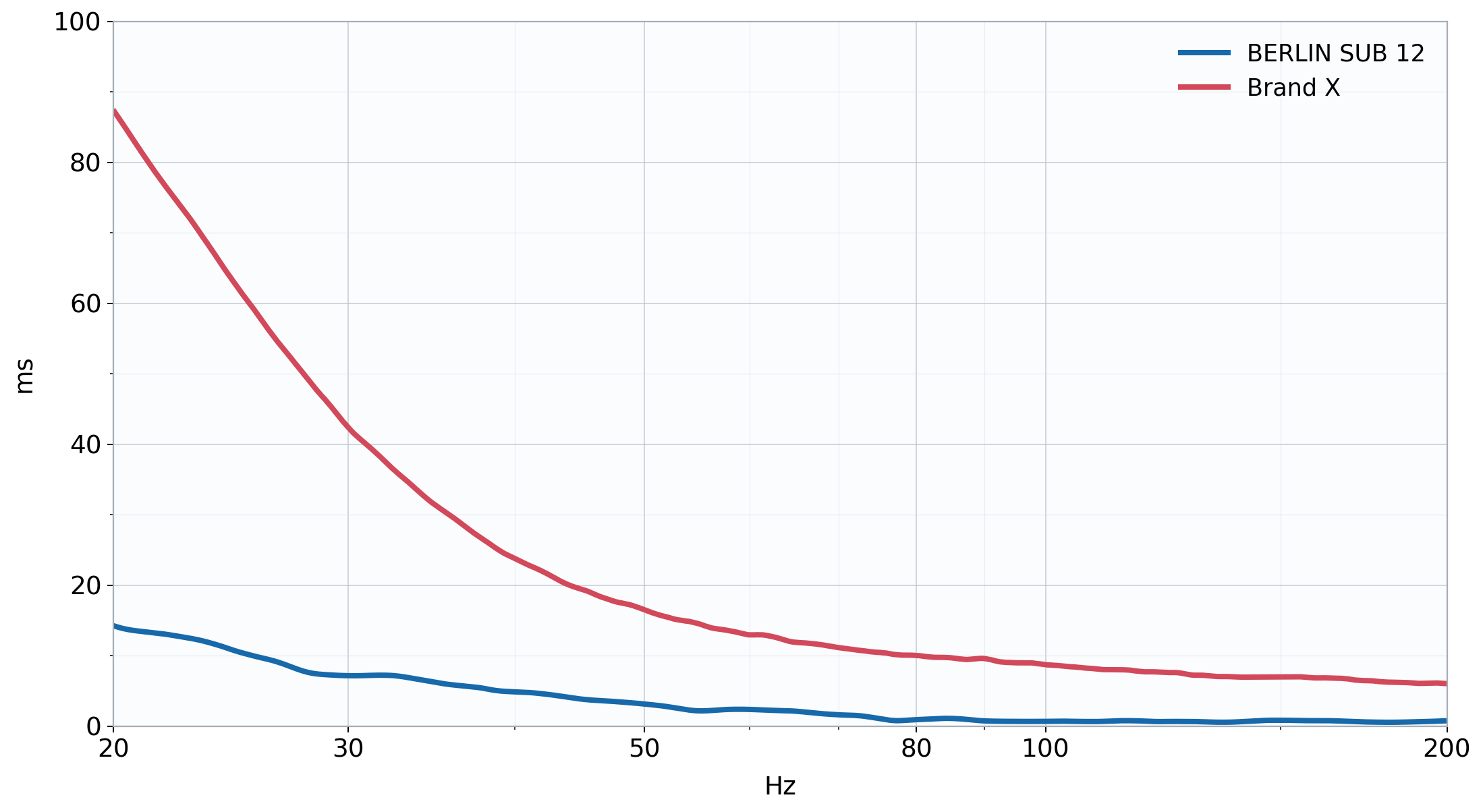
BERLIN SUB Group Delay (ms) vs. Frequency (Hz). Compared with a Leading Competitor
SPEAKERMATCH
Most loudspeakers are designed to perform well on their own. That often means they are tuned to produce as much useful bass as possible from their cabinet size. This is great when the speaker plays by itself, but once you add a subwoofer, the speaker’s natural bass roll-off becomes part of the crossover.
To make it even worse, speakers exist in many different sizes, shapes and designs. Most subwoofers don’t take roll-off from the speakers into account, which means the speaker and the subwoofer end up reproducing a lot of the same bass notes. Some frequencies become exaggerated, while others almost disappear. Even worse, the timing between the two systems is off, since the subwoofer inherently lags behind the speakers. The result is bass that sounds uneven, bloated or disconnected.
With Speakermatch™, we have developed brand-new filter types from the ground up to fix this issue. Instead of using one generic filter, BERLIN SUB can adapt its crossover and phase behaviour to match the acoustic roll-off of the exact speakers it is paired with.
The reason this works is surprisingly simple. Most loudspeakers with the same cabinet principle share remarkably similar bass roll-off behaviour. So, the biggest difference between speaker types is where that roll-off begins, not how it behaves.
Once you select your speaker type and crossover frequency, BERLIN SUB takes care of the rest by automatically adjusting its internal filtering to create a smoother acoustic handover.
For selected Argon Audio and Radiant Acoustics models, dedicated presets go even further by optimising the crossover specifically for those loudspeakers.
In plain English: Speakermatch™ helps BERLIN SUB speak your speakers’ language. Instead of sounding like a separate box adding bass, it becomes a natural extension of your loudspeakers.
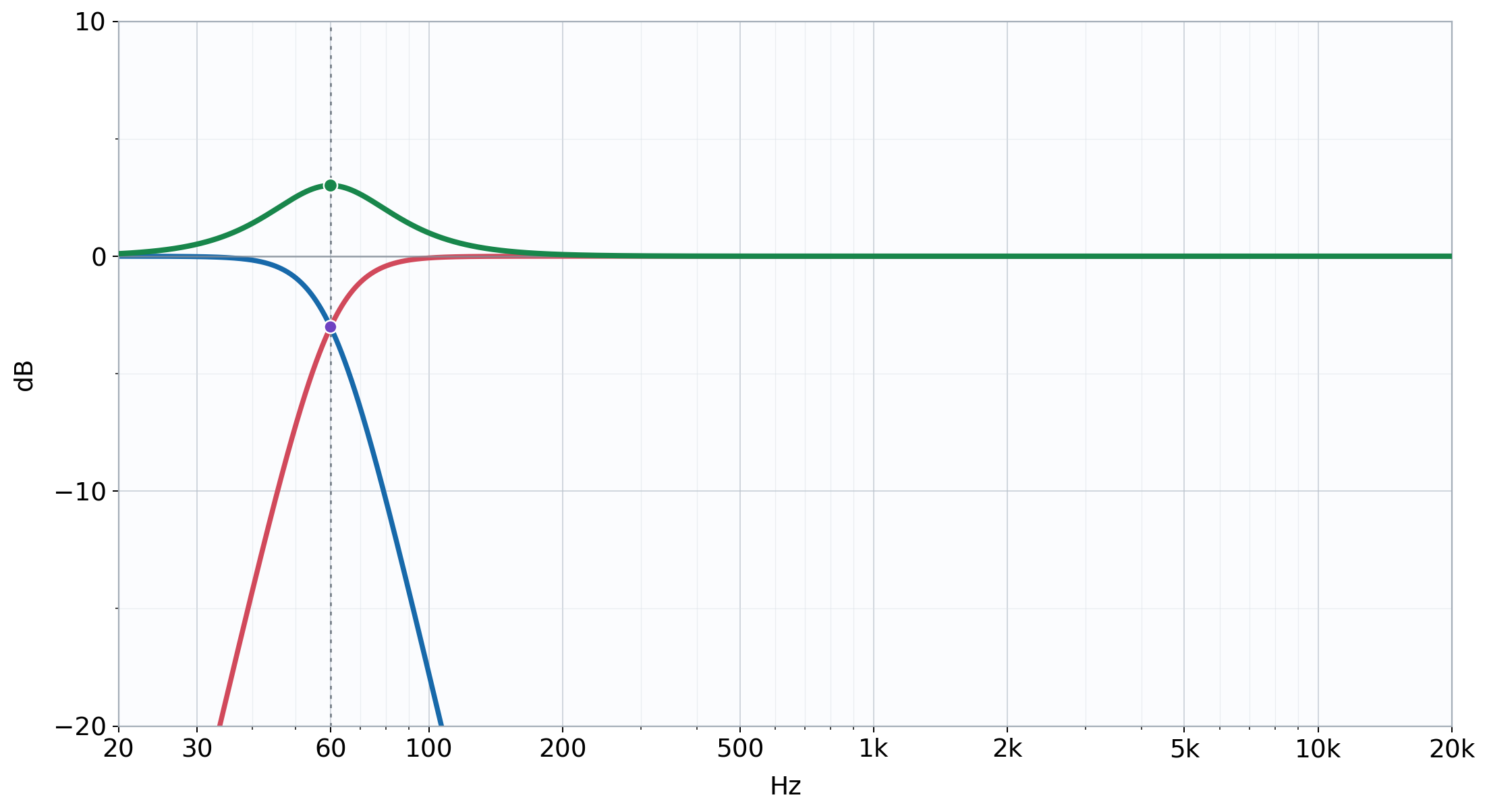
FORTE and BERLIN without Speakermatch™
Notice the 3 dB peak at the crossover point.
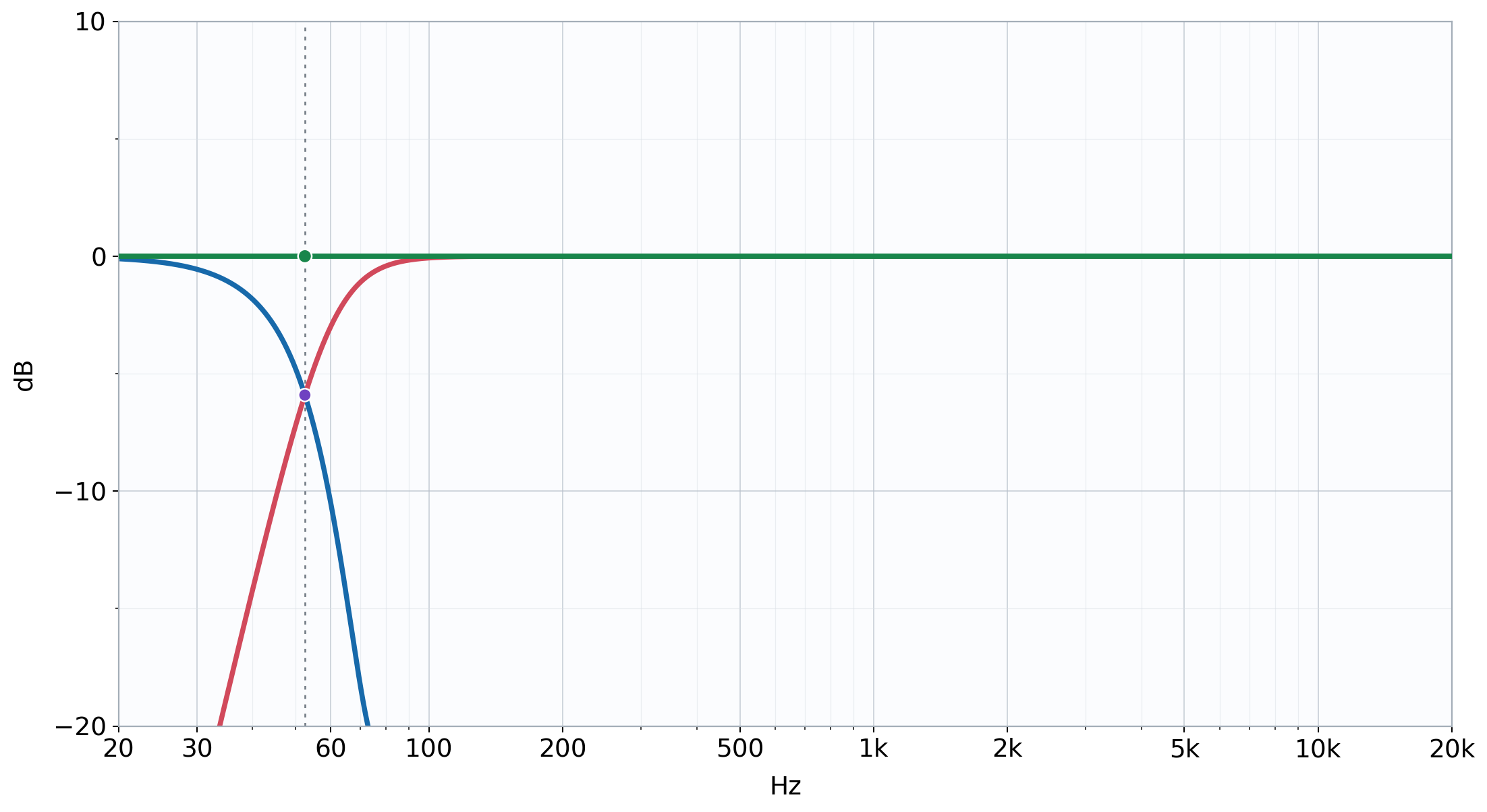
FORTE and BERLIN with Speakermatch™
Smooth transition between the speakers and subwoofer — perfectly in phase.
NOW FOR THE REALLY NERDY PART
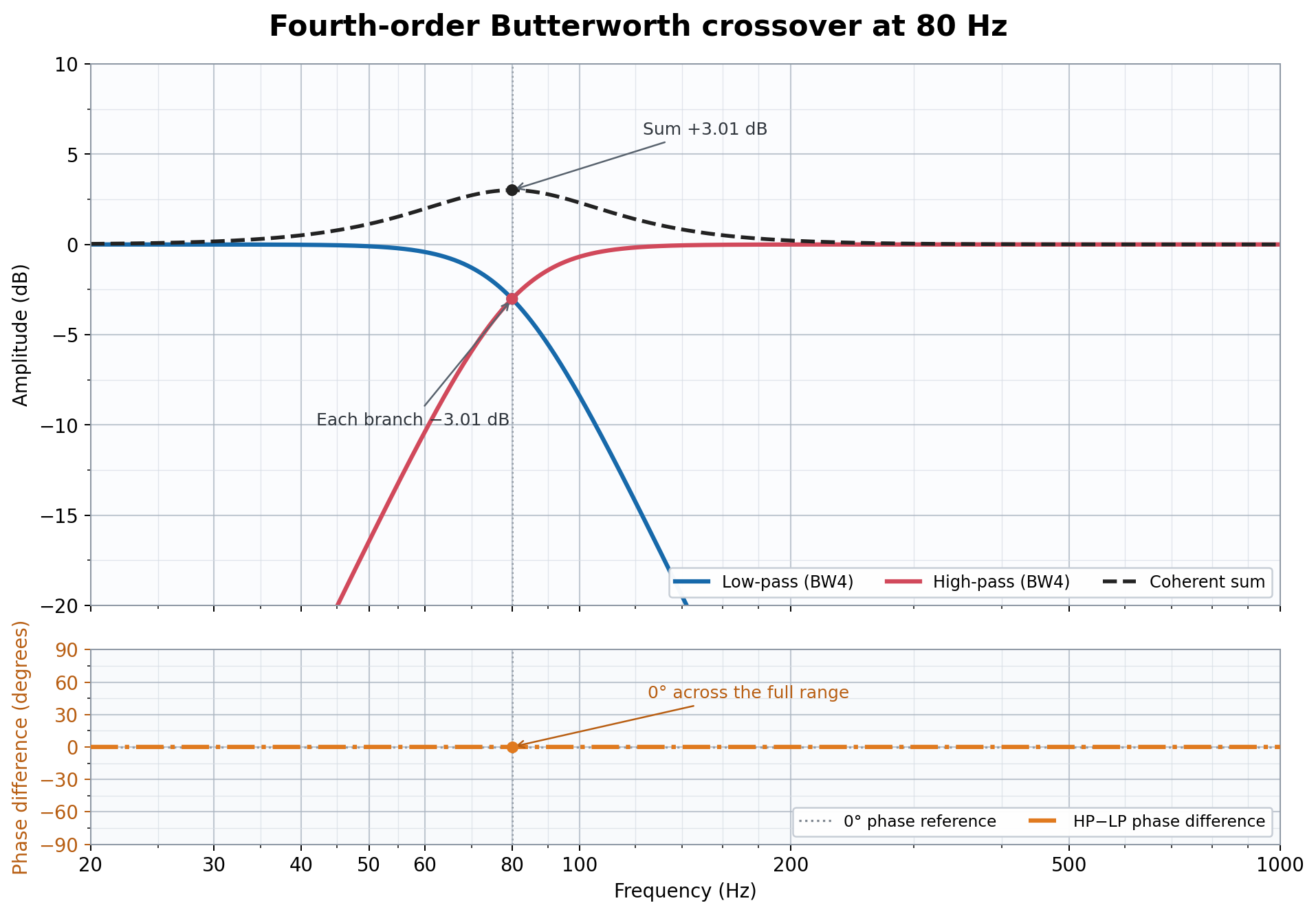
A loudspeaker’s bass roll-off is typically designed to provide a smooth, entirely flat response, often resembling a Butterworth-type response. Below its roll-off frequency, the output will typically decrease by around 12 to 24 dB per octave, depending on whether the loudspeaker uses a sealed cabinet, a port or a passive radiator.
Butterworth responses work well for loudspeakers on their own, but combining this natural roll-off with a conventionally filtered subwoofer introduces problems. If the loudspeaker and subwoofer have matching fourth-order Butterworth responses at the same crossover frequency and are in phase, their outputs combine to create a peak of approximately 3 dB around the crossover point.
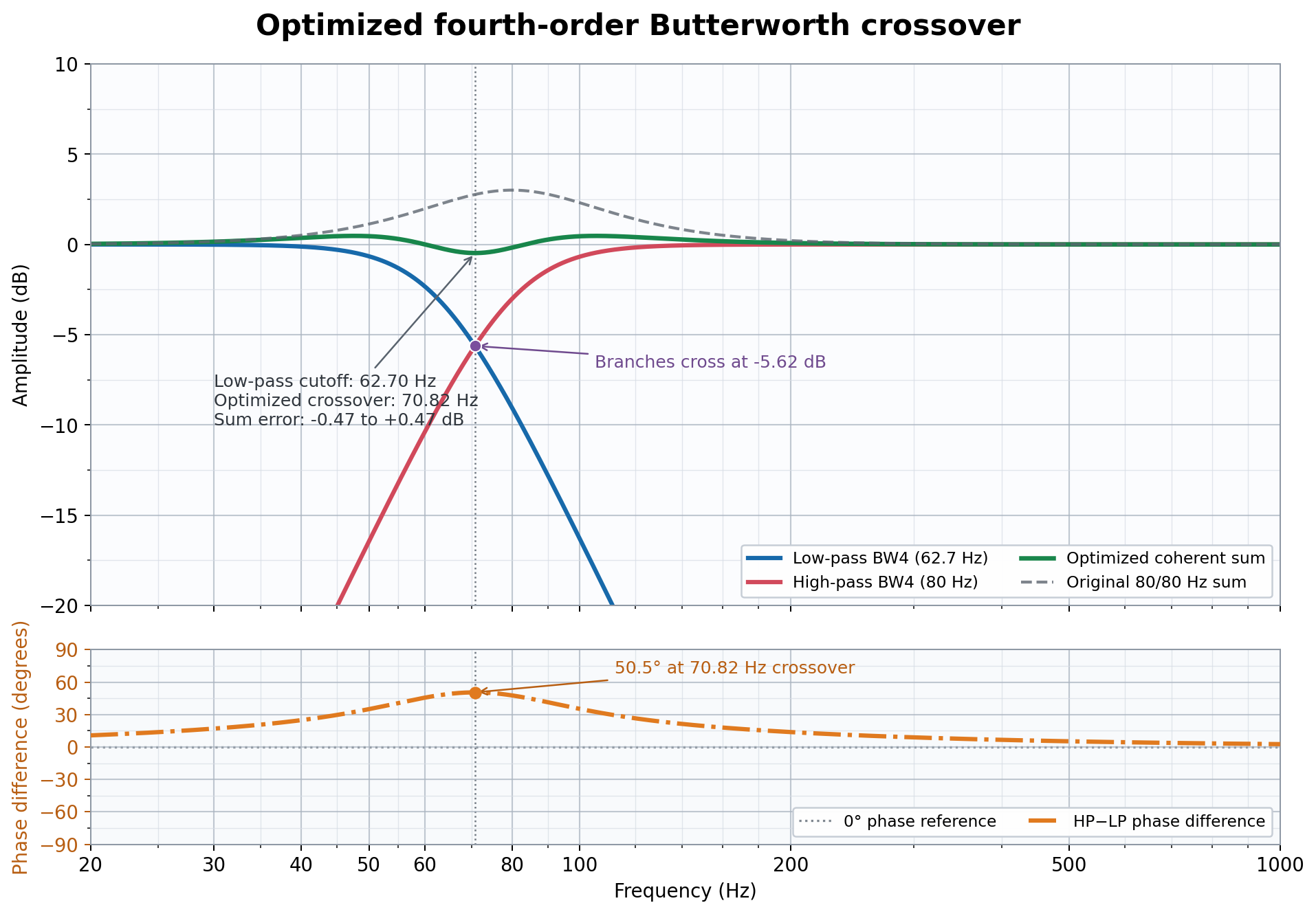
One way to reduce this peak is to move the subwoofer’s low-pass filter further down in
frequency.
As shown here, this can produce a significantly flatter combined frequency
response.
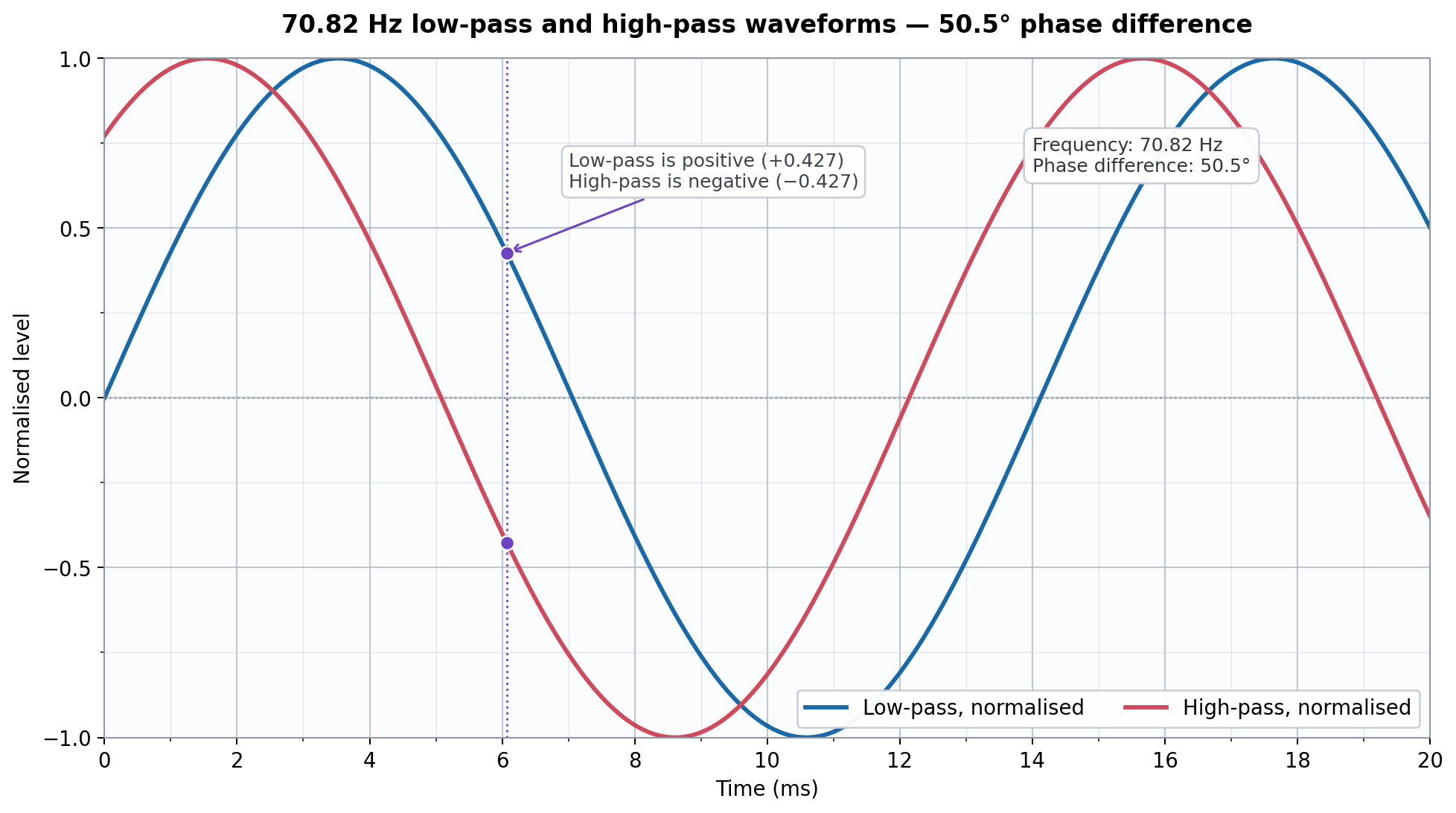
However, the flatter frequency response comes with a trade-off. Because the two filters are now operating at different frequencies, the loudspeaker and subwoofer are no longer perfectly aligned in phase. In this example, there is a phase difference of approximately 50.5° at the 70.82 Hz crossover point. At around 6 ms, the low-pass and high-pass signals are moving in opposite directions. This means their outputs partially oppose one another rather than combining perfectly.

This illustrates why frequency response alone does not tell the complete story. A
conventional crossover can be adjusted to produce a relatively flat frequency response while still leaving a phase and timing mismatch between the loudspeaker and subwoofer.
A conventional subwoofer filter already introduces phase shift and delay, and a traditional phase control can adjust the relative phase but cannot necessarily correct the frequency-dependent phase and timing behaviour introduced by the filters.
When the loudspeaker and
subwoofer are not properly aligned, part of their acoustic output can be lost through
destructive interference. The subwoofer may therefore need to work harder to achieve the required output, while some frequencies can be reduced and others reinforced.
Speakermatch™ addresses this by optimising the subwoofer for the behaviour of the specific loudspeaker it is being used with. By improving the relationship between frequency response, phase and timing, the loudspeaker and subwoofer can work together as a more coherent system with less unwanted cancellation and a smoother transition between them.
For the user, the main advantage is simplicity. Instead of relying on measurement equipment, manual phase adjustment or complex DSP correction, they simply select the loudspeaker being used and, where necessary, compensate for differences in placement between the subwoofer and the main loudspeakers. Speakermatch™ then applies the
appropriate optimisation for the system.
MADE FOR REAL LIVES AND REAL HOMES
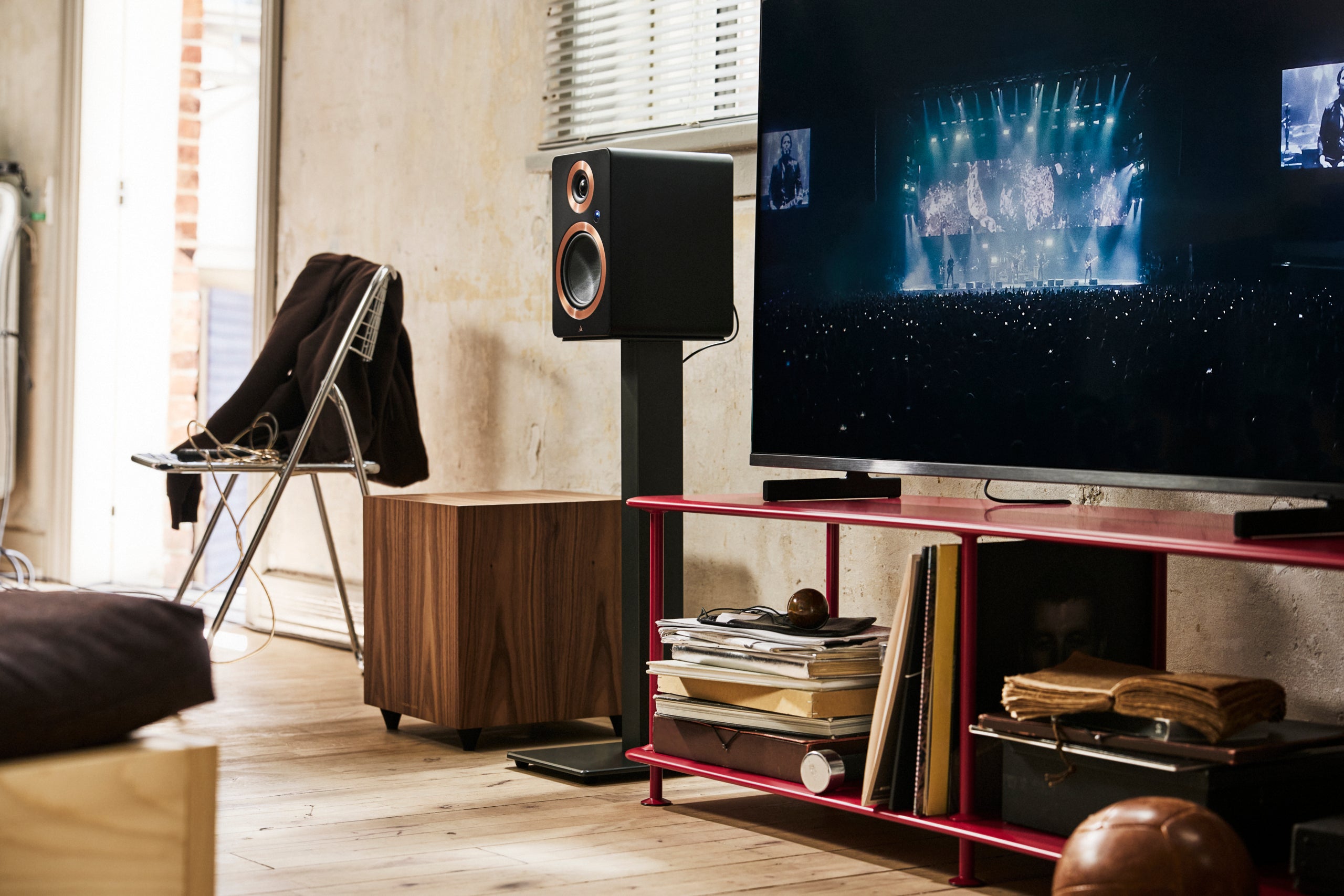
The BERLIN SUBs have been designed with real homes in mind. Their seamless Scandinavian designs will look like a natural part of almost any modern home.
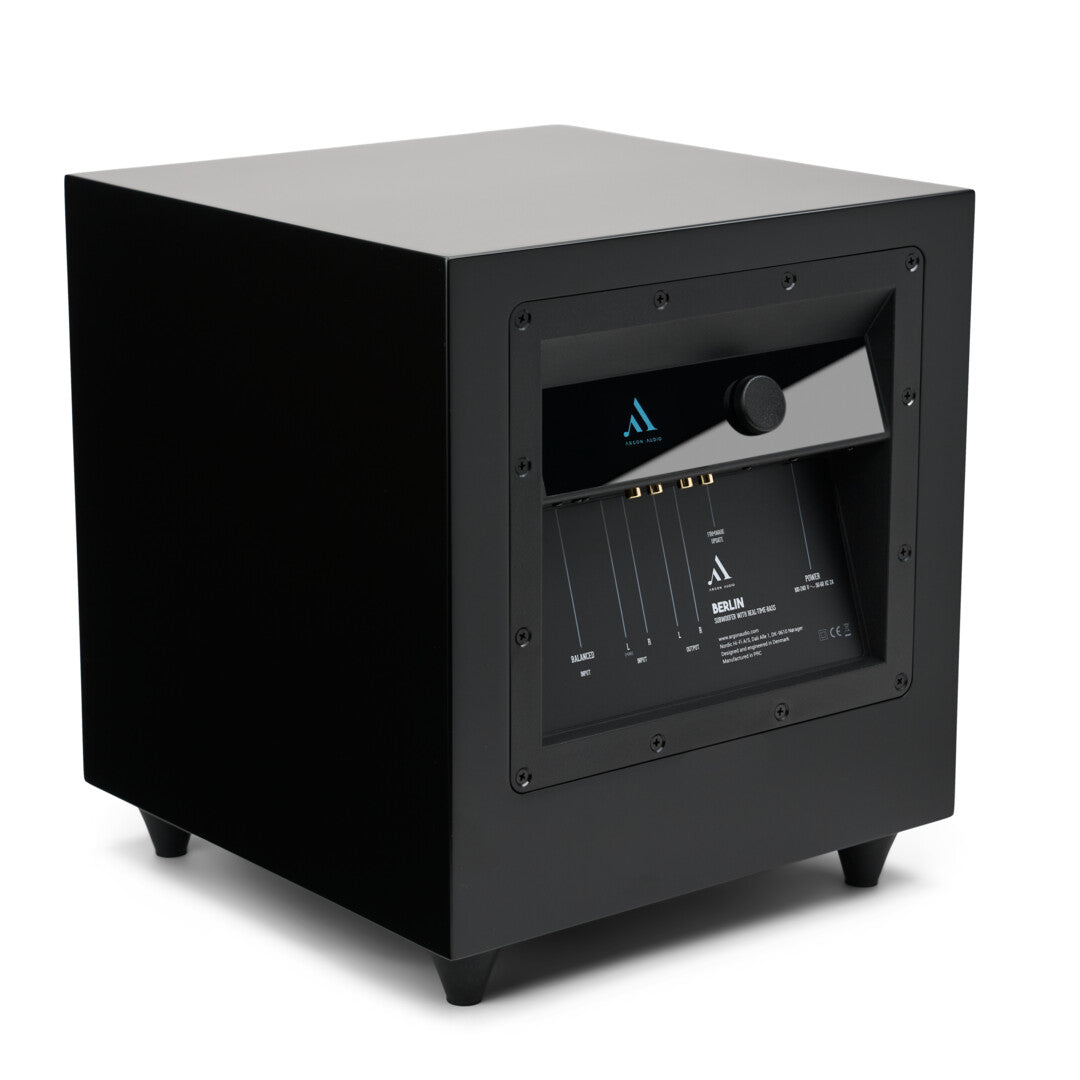
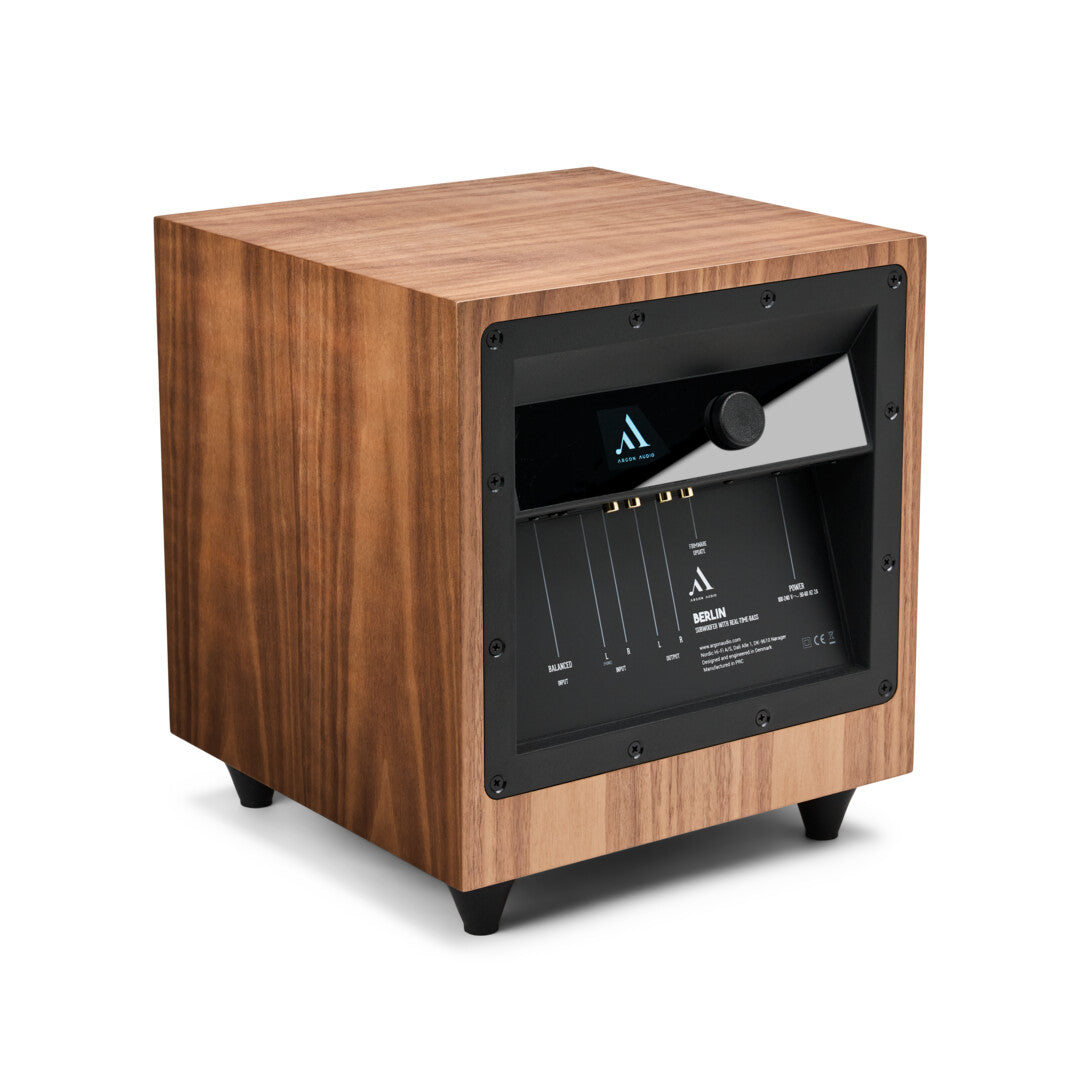
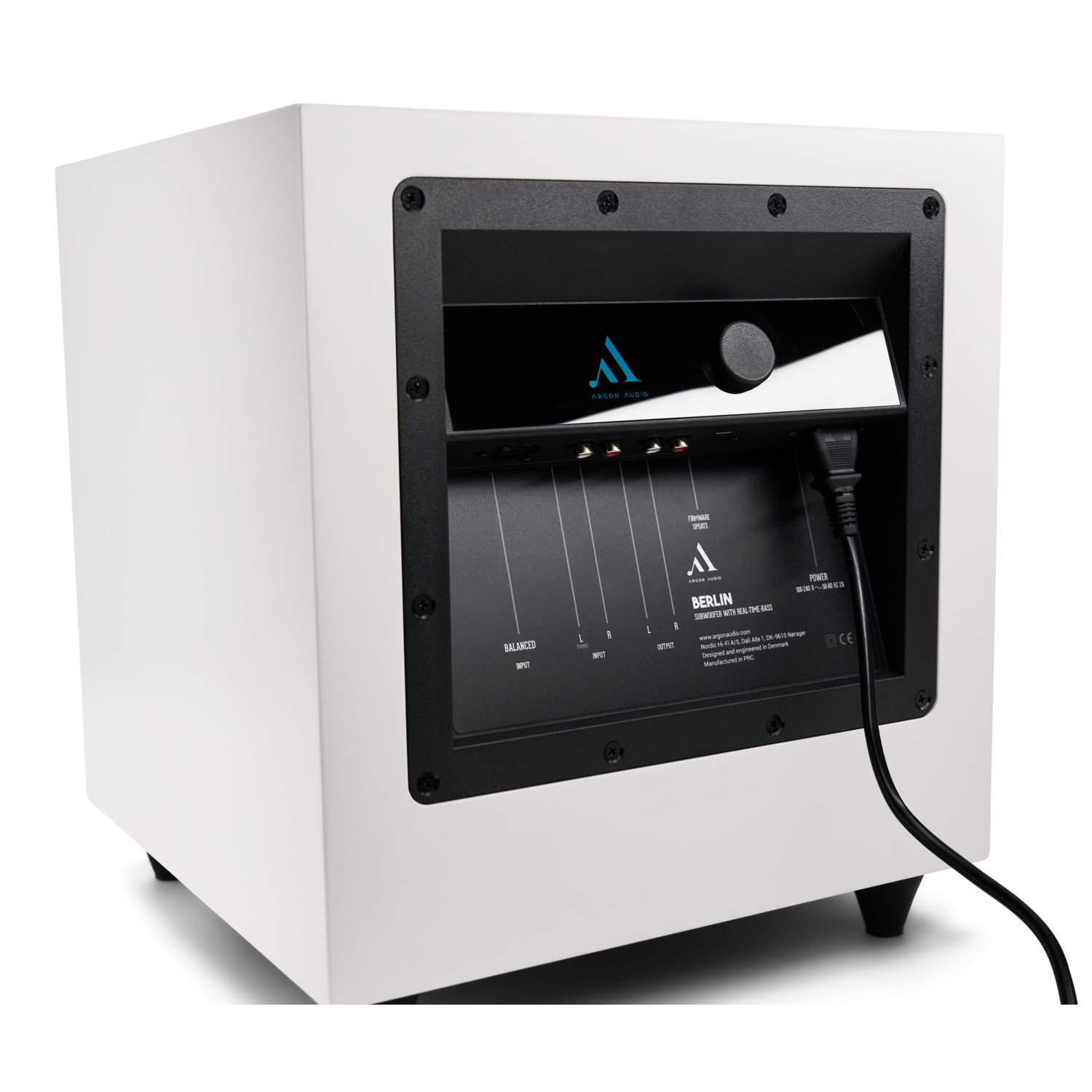
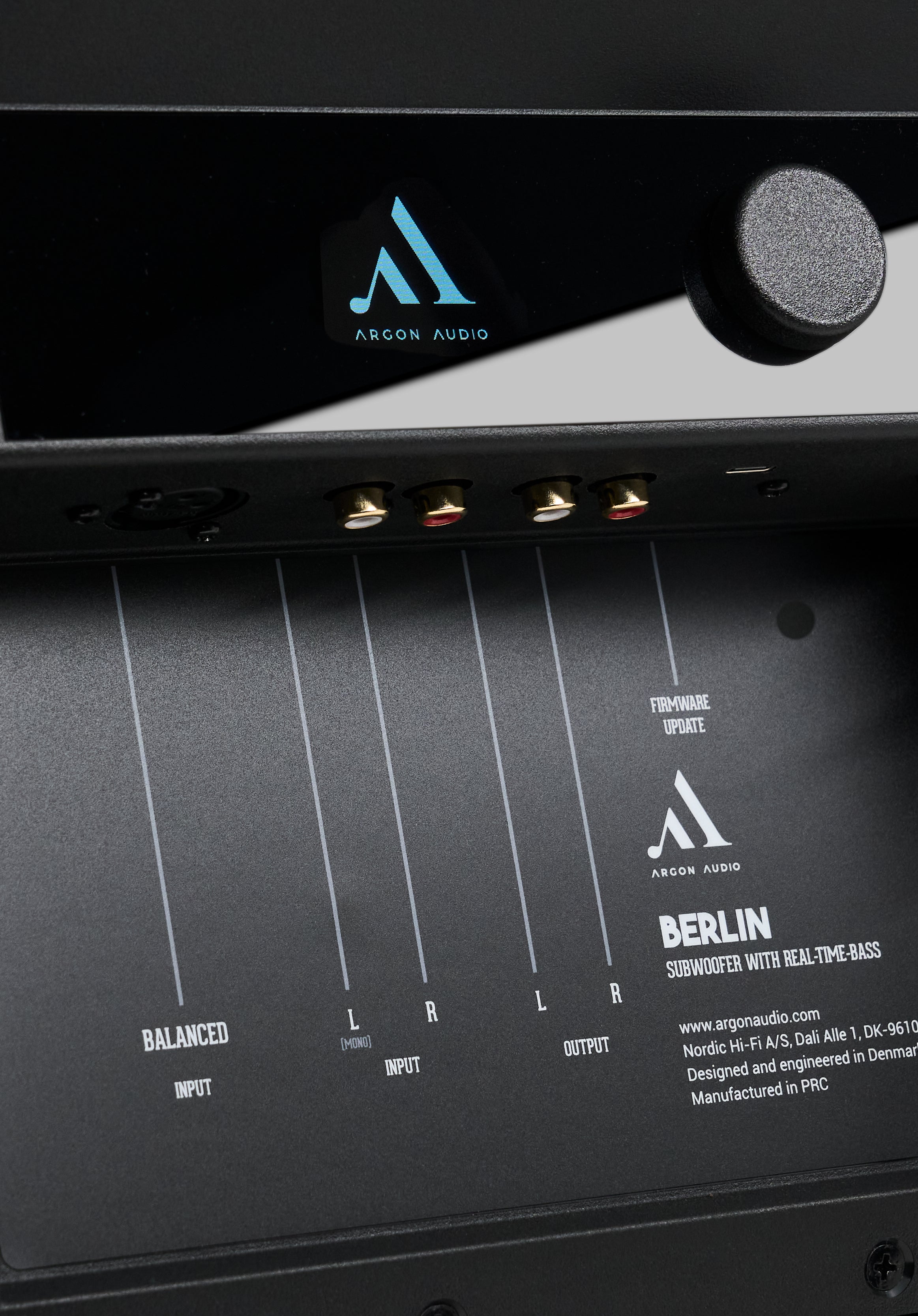
The connectors on the back are angled and recessed, allowing the subwoofer to sit flush to the wall. This matters more than it may sound. Subwoofers are often placed near walls or furniture, and bulky straight connectors can force the cabinet farther into the room.
The built-in display and one-knob menu system make everyday adjustments straightforward. From the rear panel, you can control volume, low-pass filter, delay, phase, subsonic filter, Speakermatch™, MATRIX Wireless™, standby behaviour, display settings and room EQ. You can even rotate the digital display 180 degrees, so you can operate it from the top down.
BERLIN SUB also features intelligent signal detection. This means that the subs use advanced signal detection logic designed to respond to real audio signals, not random impulses, static noise or amplifier artefacts. In practice, this helps make auto on/off behaviour more reliable and less annoying in everyday use, since the subwoofer going into or out of standby will not produce any clicking or popping noises, and you shouldn’t experience any cut-outs of the signals.
Of course, the DSP-based protection system also keeps the subwoofer operating within safe limits, helping protect the driver and amplifier during demanding playback.
All of this is to say: you shouldn’t have to think about your subwoofer. And with the BERLIN SUB, once it’s installed, you won’t have to.
All you have to do is enjoy it.